
Dengue Fever
What is Dengue fever?
Dengue Fever is an acute mosquito-borne infection caused by the dengue viruses. The dengue viruses encompass 4 different serotypes. The incubation period ranges from 3 to 14 days, commonly 4 to 7 days. Dengue fever is clinically characterized by sudden onset of high fever, severe headache, pain behind the eyes, joint and muscle pain, loss of appetite, nausea and rash. Some infected people may not develop apparent symptoms, and some may only have mild symptoms like fever, e.g. young children may exhibit a milder non-specific febrile illness with rash.
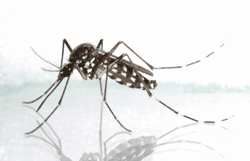
Aedes albopictus
(Acknowledgement: Pest Control Advisory Section, Food and Environmental Hygiene Department)
The symptoms of first infection are usually mild. Once recovered, immunity to that serotype of dengue virus will develop but subsequent infections with other serotypes are more likely to result in severe dengue. Severe dengue is a severe and potentially fatal complication of dengue fever.
Where is dengue fever commonly found, and which regions are particularly affected by the disease?Dengue fever is endemic in more than 100 countries across Africa, the Americas, the Eastern Mediterranean, Southeast Asia and the Western Pacific. This includes various popular tourist destinations for Hong Kong people including the Philippines, Thailand, Indonesia, Malaysia and Singapore. Travellers visiting these places are advised to protect themselves against mosquito bites.
For the latest updates on countries reporting recent outbreaks, please click here .
Imported cases have been reported in Hong Kong. For the places of infection of imported dengue fever cases in Hong Kong and latest situation of dengue fever in neighbouring and overseas countries and areas, click here.
The Centers for Disease Control and Prevention also provides maps of dengue fever affected areas.
How does it spread?
Dengue virus is transmitted to human through the bites of infective female Aedes mosquitoes. This is a day-biting species with increased biting activities for 2 hours after sunrise and several hours before sunset. When a patient suffering from dengue fever is bitten by a vector mosquito, the mosquito is infected and it may spread the disease by biting other people. It cannot be spread directly from person to person.
How can you prevent it?
At present, there is no locally registered dengue vaccine available in Hong Kong. Travellers should protect themselves against mosquito bites. The personal protection measures are as follows:
- Wear loose, light-coloured, long-sleeved tops and trousers;
- Avoid using fragrant cosmetics or skin care products;
- Rest in air-conditioned or well-screened rooms;
- Use aerosol insecticide indoor and use bed nets if sleeping areas are not air-conditioned or screened.
- Use insect repellents containing DEET on exposed skin and clothings;
- Re-apply insect repellents according to instructions;
- If travelling in endemic rural areas, carry a portable bed net and apply permethrin on it as well as to clothes. Permethrin should not be applied to skin.
How is it treated?
There is no specific medication for dengue fever or severe dengue. Dengue fever is mostly self-limiting. Symptomatic treatment is given to relieve discomfort. Patients with severe dengue should be treated promptly with supportive management. The mainstay of treatment is to maintain the circulating fluid volume.
What is the difference between dengue fever and dengue haemorrhagic fever?
Dengue Haemorrhagic Fever (DHF) is a severe form of Dengue Fever (DF) with increased bleeding tendency; the mortality rate can be as high as 20%. DHF usually occur in persons with previous history of infection caused by different serotype of dengue virus.
Where to find the latest updates on dengue fever, locally and internationally?
For the latest updates on dengue fever, both locally and internationally, please refer to the press releases issued by the Centre for Health Protection. To find the press release, visit the thematic webpage on dengue fever at https://www.chp.gov.hk/en/features/38847.html and click on the ‘Press Releases’ hyperlink located in the ‘Details’ table at the bottom.